
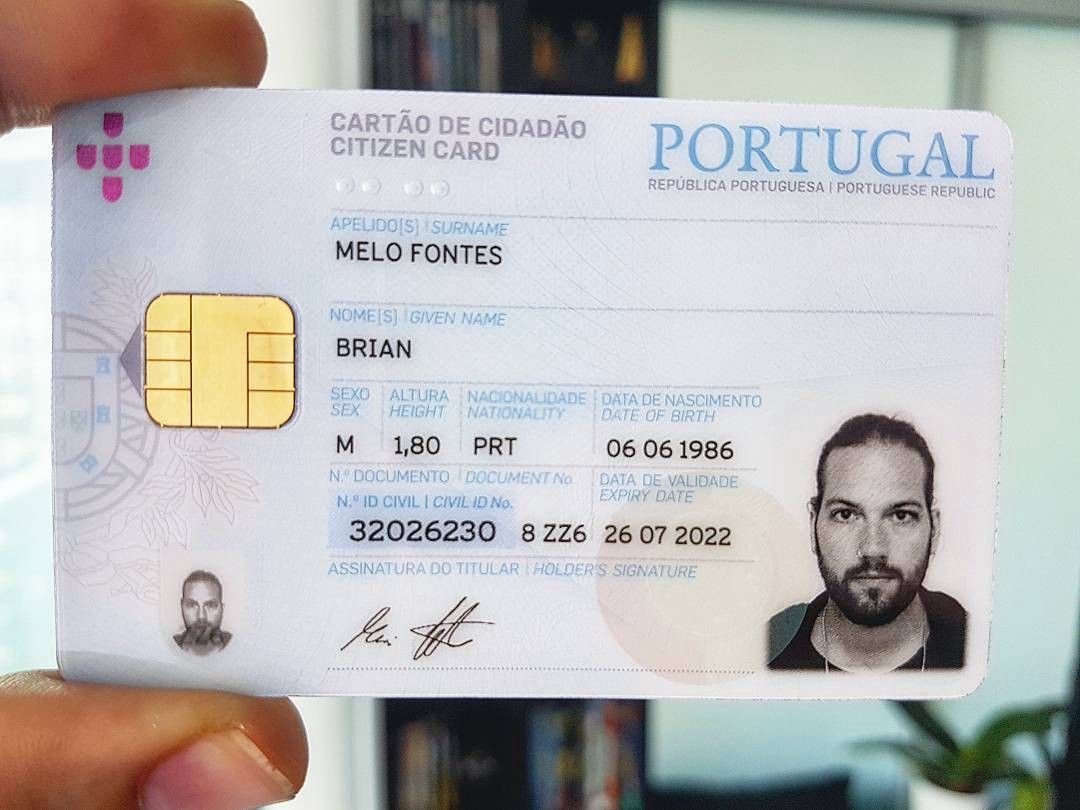

PORTUGUESE IDENTITY CARD
€350.00
A NEW PORTUGUESE ID CARD SCHEME
The first pilot phase of the Portuguese ID Card also known as Cartão de Cidadão started February 14, 2007, in the Azores region. The full roll out started in 2008.
In 2014, all Portuguese citizens have their new national identity card in hand replacing the old paper-based document.
The goal of issuing a Portuguese ID Card was to revolutionize the way in which Portuguese citizens interact with the government.
First, simplification.
THE NEW PORTUGUESE ID CARD REPLACES 5 CARDS
The card replaces 5 different physical ID documents:
Civil identification card – the former paper-based Portuguese ID Card
Taxation card
Voting card
Social security card
Healthcare card.
The new Portuguese ID Card known as Cartão do Cidadão or citizen's card enables individuals to identify themselves in front of officials.
In addition, as of 2019, registered foreigners in Portugal are able to apply for the citizen card.
A NEW PORTUGUESE IDENTITY CARD SYSTEM
The first pilot phase of the Portuguese identity card, also known as the Cartão de Cidadão, began in the Azores on February 14, 2007. The full rollout began in 2008.
In 2014, all Portuguese citizens received their new identity card, which replaced the old paper document.
The aim of issuing the Portuguese identity card was to revolutionise the way Portuguese citizens interact with the government.
First: simplification.
THE NEW PORTUGUESE ID CARD REPLACES FIVE CARDS
The ID card replaces five different physical identification documents:
Identity card – the former paper-based Portuguese identity card
tax card
Voting card
Social security card
health insurance card
The new Portuguese identity card, known as the Cartão do Cidadão or Citizen Card, allows individuals to identify themselves to authorities.
In addition, registered foreigners in Portugal can apply for the Citizen Card from 2019.
THEN A NEW DIMENSION.
A NEW PORTUGUESE ID CARD FOR ONLINE AUTHENTICATION
The second objective is to use the card as a completely new tool for electronic signatures and online authentication in order to promote the development of electronic transactions and provide security to citizens in the digital age.
For identification and authentication, cardholders enter a secret PIN code, after which the card generates a digital signature for secure declarations and electronic administrative procedures.
This application provides the necessary cryptographic means for secure access to the e-government portal.
Since the Portuguese Constitution prohibits a central database of names, the citizen card contains several identification features on the front and back (identity card number, social security number, tax number, health insurance number).
Many public services are now available online, and procedures that once took hours (obtaining civil registers/birth certificates, social security declarations, etc.) are now only seconds away.
Since 2014, over 45% of cardholders have activated their digital certificates.
This project is supported, among other things, by the very active website www.cartaodecidadao.pt.
And even more:
PORTUGUESE IDENTITY CARD AND BIOMETRICS
The Portuguese identity card supports biometric authentication when needed, as fingerprints are securely stored in the card's microprocessor.
The Match-on-Card mechanism enables biometric authentication without a central biometric database. This is strictly prohibited in Portugal.
Biometric data never leaves the chip card and is therefore protected at all times.
The card processor performs the check and answers the question: Does the presented fingerprint match the one stored on the card?
A STRONG PARTNERSHIP
Following the electronic passport project, the Portuguese national printing house INCM (Imprensa Nacional Casa da Moeda SA) had another opportunity to further expand its unique expertise.
In 2006, INCM selected Thales as prime contractor for the digital security solution for the national electronic identity card (Sealys eID). This included the secure operating system, the personalization system (Coesys Issuance solution), as well as the applications, middleware, and associated helpdesk services, together with Zetes Burótica, the Portuguese subsidiary of the Belgian Zetes Industries.
The Portuguese government opted for a secure identity document based on the IAS (Identification, Authentication and Signature) specifications – the first in Europe.
BEYOND THE CITIZEN CARD
Portugal is a fascinating example of state modernization.
When Portugal decided a few years ago to accelerate the implementation of its e-government plan and drastically reduce bureaucracy, the goal was to transform the public sector into a collaborative, inclusive institution and to make Portugal one of the leading countries in terms of service quality for citizens and businesses.
The goals of a more citizen-oriented society have rarely been advocated from the outset with such emphasis and such a comprehensive understanding of the issues.
Citizens' shop
PORTUGAL AND STATE MODERNIZATION – 15 YEARS AGO
At the beginning of the last decade, Portugal was still an extremely centralized country with difficult-to-bridge gaps between local and central authorities.
The Internet had made massive inroads into the country's elite, but few citizens used the Internet or online services.
Therefore, the challenge of modernising the state through digital means, bringing citizens and authorities closer together through digital communication channels and thus strengthening social cohesion, seemed insurmountable.
It seemed as if the country had to wait for change to come from the next generation, who were more familiar with the new methods of communication.
Bold statements for a new vision
Nevertheless, Portugal made the following bold commitments:
Are the administrative bodies too fragmented? Interdisciplinary cooperation will be a priority.
rity.
The public is very skeptical about this change. The benefits of this change will initially be concrete and visible before they translate into the digital environment.
Do back offices impose too many restrictions and impair the quality of government service? The new organization will be fully focused on the needs of citizens and advance the citizen-centric e-government vision as far as possible without compromising administrative efficiency.
SIMPLEX AND SIMPLEX+ MODERNIZATION PROGRAMS
SIMPLEX
Between 2006 and 2011, over 1,000 measures to simplify administration and legislation, as well as e-government, were successfully implemented as part of the so-called Simplex program, the name of the government's modernization initiative.
Two examples:
The citizen card, introduced 10 years ago, replaces five documents.
The Citizen Shop provides a central contact point for public administration and many private services. In 2017, there were 533 Citizen Shops offering around 200 public services. Overall, they had a very positive impact on the lives of citizens and businesses and reduced administrative costs. The program's implementation rate has consistently exceeded 80%.
Some of the programme's measures have been recognised and received international awards, both from the United Nations (2018 report – see page 39) and from the European Commission.
Simplex stands for positive changes and reducing bureaucracy in the public sector.
SIMPLEX+
SIMPLEX+, the new program, is cross-sectoral and covers all areas in which government is actively involved. It maintains its common approach to the various aspects of simplification while addressing new challenges in a new era.
Simplex+ is remarkable in many ways.
First, it is more participatory, co-produced, and implemented with full transparency and accountability.
It promotes innovation and invites innovators to engage with central administration. The "Startup Simplex" competition was launched in 2017. Its goal is to reward innovative ideas for products and services that simplify the interaction of citizens and businesses with public services.
The Simplex program extends the focus on simplification beyond public services to include measures such as easier bank account opening that require cooperation between the public and private sectors.
The result?
Between 2016 and 2018, Portugal improved by nine places in the United Nations e-Government Development Index (EGDI).
LESSONS FROM PORTUGUESE EXPERIENCES
At a time when secure digital identities are considered key to using digital services and digital dividends, it is worth drawing lessons from the Portuguese experience:
Durability – successful transformation and implementation of the new system are based on unchanging fundamentals and take time.
Guidance – When things change, however, changes need to be explained. Guidance needs to be provided, and it's important to ensure positive feedback to build people's trust.
Afterward, it's important to provide highly visible information—such as citizen spots and citizen cards—to encourage adoption before virtual implementation. This is especially true in areas where digital technology hasn't yet reached enough people.



 English (UK)
  Deutsch
  Nederlands
  Italiano
  Español
  Français
  Dansk
Dansk  العربية
  Tiếng Việt
  ភាសាខ្មែរ
  Hrvatski
  简体中文
简体中文  Српски језик
  Slovenčina
  Slovenščina
  Português
  Bosanski
  Čeština
  Suomi
Suomi