
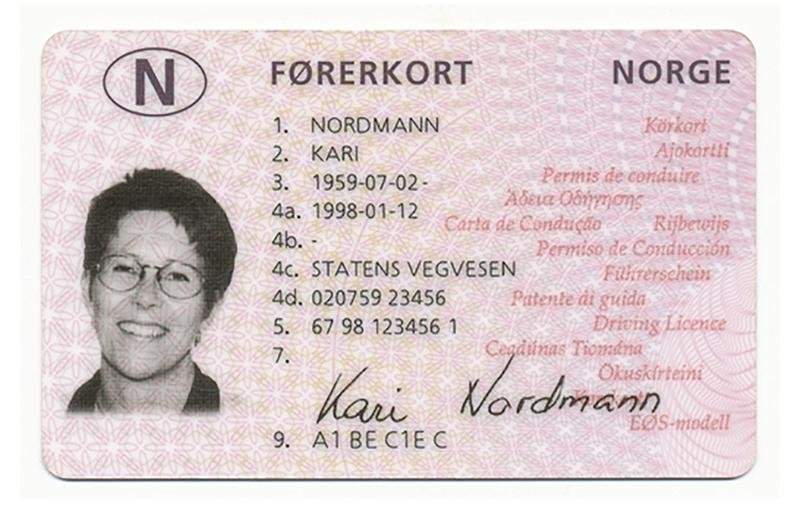

NORWAY DRIVING LICENSE
€1,000.00
GET A NORWAY DRIVING LICENSE.
Without a Norwegian driving license
If you have a driver's license that wasn't obtained in an EU country or the US, you can use it on Norwegian roads. However, this is only possible for three months. After that, you'll need to repeat the process for obtaining a Norwegian driver's license, both theoretically and practically. In this article, we'll explain how.
ALGORITHM FOR OBTAINING A DRIVING LICENSE IN NORWAY
Having a driver's license in Norway is extremely convenient, as it is very inconvenient and expensive to drive without a car in many small towns. However, the process of obtaining a driver's license in Norway is cumbersome, lengthy, and expensive (totaling over 3,000 euros or 150,000 rubles). A Norwegian driver's license holder is almost a god, having faced so many difficulties on the road to obtaining a license! The Norwegian driver's license used to be issued up to the age of 100. Now it is limited to 75. This means that the license is not renewed every 10 years, as is the case in Russia, for example. According to statistics, 50,000 out of 5 million people (1 percent) in Norway take driver's training annually, and about 80 percent of them obtain a driver's license. Norwegians usually pass the test on the second or third attempt.
Certain requirements must be met to obtain a Norwegian driving license:
Foreign nationals may register for the procedure to obtain a Norwegian driving license no earlier than six months after receiving their residence permit.
Students begin driving lessons at age 16, but are not allowed to drive until age 18. They, as well as anyone under the age of 25 who has never obtained a foreign driver's license, attend the main (introductory) course. In Norway, parents spend a lot of money teaching their children to drive, as the rest of their education (including higher education) is free in the country.
START WITH THE THEORY
Any student at a Norwegian driving school (and there are about 600 of them in the country) can learn the theory knowledge independently by borrowing a driver's manual from the library or using special websites. It usually takes about a month, with those with poor Norwegian or English skills having the most difficulty (you can take the test in either of these languages). Registration on a special website is required for the theory test. After selecting a time and place, the computer must answer various questions, often the same ones but rephrased. There are 45 theoretical questions in total. You are allowed a maximum of seven errors. This means that 85% of the answers must be correct, otherwise you will fail the theory test. You have an hour and a half to answer all 45 questions. The test costs approximately €300. If you pass on the first attempt, the exam is free of charge. Each subsequent attempt will add a set amount to the applicant's budget.
If you pass the theory test, your results are valid for three years. However, you must also take the practical test within this time. If you fail, you must retake the theory test as a beginner.
PRACTICAL LESSONS
The number of lessons depends on the results of the previous test. If the student fails the previous test, they will not be admitted to the next lesson. The driving instructor pays close attention to the quality of the training. There are approximately 1,500 instructors working at driving schools in Norway. Each of them is a top-notch specialist who has completed a special two-year university training program to become a driver and obtained a driver's license. A simple "agreement" with the instructor is not enough. Students must learn more intensively and acquire the necessary skills automatically.
Students train on new vehicles with manual transmissions. A car with an automatic transmission is also possible, but in this case, a special note will be entered on your driver's license, and you will only be allowed to drive a car with an automatic transmission.
A practical course consists of four sections, each of which is paid for separately.
The first aid course costs 85 euros. The theory lasts approximately 3.5 hours. Along the way, the instructors present various situations in which the skills required in real life must be demonstrated. Example: There is an accident. What does the Russian driver do when he sees a broken-down car? He runs out of the car and runs to the injured, while simultaneously trying to call an ambulance on his cell phone. The Norwegian driver must get the vest and put it on, then pull out the warning triangle and mark the accident scene, examine the injured, and dial 113. He must then answer three questions: their name, where they are, and how many injured people are there (if they are conscious, state what they are complaining about). Only in extreme emergencies is he allowed to provide first aid himself. It is believed that doing so could cause more harm than good. Especially since the ambulance c
The journeys are very fast. Traffic jams clear immediately to allow emergency services to pass. Driving past a car accident is prohibited—doing so will result in a driver's license suspension and potentially a prison sentence. However, each participant learns basic first aid skills: they learn how to properly immobilize the head if the victim is unconscious and are prohibited from administering water if internal bleeding is suspected, etc.
Night driving lessons are only offered from autumn to spring. This course cannot be completed during other periods in Norway due to the polar days (the "white nights"). Dolls are equipped with reflectors or dark clothing; there are braking exercises at different speeds and in different situations. The driving instructor can deliberately distract the student with conversation and then unexpectedly show them a model moose crossing the road or a pedestrian on the dashboard. The student's reaction is automatically incorporated. After this, the night driving course is considered passed.
Safe driving requires practical training on slippery roads. There are training areas with equipped areas where the road surface is covered with oil or metal sheets to simulate ice. Various obstacles that could cause the vehicle to skid or lose control are driven over at different speeds. The instructor is nearby, but the learner driver must drive independently. Slippery surfaces are practiced on both downhill and uphill slopes. The instructor can hand over the old vehicle and deactivate all assistance systems.
In Norway, great importance is placed on environmental protection and exhaust emissions. Therefore, you must be able to drive at the correct speed, avoid unnecessary clutch depressing, choose the right speed, and avoid braking or pressing the accelerator hard. Driving instructors remind you of this and constantly emphasize it.
The driving safety course costs 660 euros.
The final training phase consists of approximately 13 hours of theory and practice (this time can be increased or reduced depending on the student's individual progress). This includes two long-distance trips (4–6 hours) with two students, with one driving the car "there" and the other "back." There are driving sessions in busy urban areas, overtaking exercises on the highway, and more. Each driving lesson costs €73.
After completing the full training, the instructor will call a specialist from the Norwegian Road Administration (not a police officer!), who will ask a few questions about the vehicle's structure and then observe a one-hour drive through the city, including parking, reversing, etc. The test costs €115. This includes the cost of renting a car from the driving school (€230). If everything passes, a driver's license form (€30) is paid, which will be mailed the day after the final test.
If you already have a Norwegian driver's license, you may want to consider an international driver's license, which allows you to drive outside the EU (even though Norway is not part of the EU). These rights can be registered through our website. We invite you to quickly and easily obtain an international driver's license—without any formalities!
In Norway, different rules apply to driving licenses from EU/EEA countries and those from non-EU/EEA countries. There is also a difference between being able to drive in Norway with a foreign driving license and the right to exchange it for a Norwegian driving license.
Generally, driving licenses from EU/EEA countries can be used in Norway for the duration of their validity and exchanged for a Norwegian driving license without a test. The rules are stricter for driving licenses from non-EU/EEA countries. Driving licenses from most non-EU/EEA countries can be used in Norway for up to three months. Driving licenses from only a few of these countries can be exchanged for a Norwegian driving license, provided you pass a new practical driving test (and in some cases, a theory test) within the specified time limits.
This distinction arises from Norway's obligation under the EEA Agreement to implement EU driving license regulations. A key principle of these regulations is the mutual recognition of driving licenses. Norway has no comparable agreements with countries outside the EU/EEA.
Information on using Norwegian driving licenses abroad can be found here.





 English (UK)
  Deutsch
  Nederlands
  Italiano
  Español
  Français
  Dansk
Dansk  العربية
  Tiếng Việt
  ភាសាខ្មែរ
  Hrvatski
  简体中文
简体中文  Српски језик
  Slovenčina
  Slovenščina
  Português
  Bosanski
  Čeština
  Suomi
Suomi